The Critical Role of the LPG Vaporizer
Liquefied Petroleum Gas (LPG), a versatile and clean-burning fuel, is a cornerstone of energy supply for countless industrial, commercial, and agricultural applications. From heating massive warehouses and powering industrial furnaces to running agricultural dryers and providing backup fuel for power generation, LPG offers a reliable and efficient energy source. However, to be used effectively, LPG must transition from its stored liquid state to a gaseous state. This process, known as vaporization, is critical. While a certain amount of natural vaporization occurs in the storage tank, it is often insufficient to meet the high, continuous, or peak demands of modern operations. This is where the LPG vaporizer comes in—a specialized piece of equipment designed to artificially accelerate this phase change, ensuring a steady, reliable, and high-volume supply of gas to your equipment. This comprehensive guide will demystify the world of LPG vaporizers, exploring the different types available, their specific use-cases, and the essential criteria you need to consider to choose the right vaporizer for your business.
How an LPG Vaporizer Works
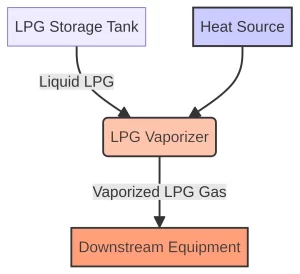
A vaporizer is essentially a heat exchanger that facilitates the phase change from liquid to gas. The core function can be summarized as follows:
Why Natural Vaporization Isn’t Enough
LPG is stored as a liquid under pressure. To become a usable gas, it must absorb heat from its surroundings. In a storage tank, this heat is absorbed from the ambient air through the tank walls. This is called natural vaporization. The rate of natural vaporization is heavily influenced by three factors:
1.Ambient Temperature: Colder temperatures significantly slow down the vaporization process.
2.Liquid Level in the Tank: As the liquid level drops, the “wetted surface area” (the area of the tank wall in contact with the liquid) decreases, reducing the heat transfer surface.
3.Demand Rate: If the rate at which your equipment consumes gas exceeds the natural vaporization rate, the pressure inside the tank will drop rapidly, leading to a phenomenon called “tank chilling” or “auto-refrigeration.” This further slows vaporization and can eventually starve your system of fuel, leading to costly shutdowns.
The Problem of Heavy Ends
Another critical reason to use a vaporizer is to eliminate the accumulation of heavy ends. LPG is not a single compound; it is a mixture of hydrocarbons, primarily propane and butane. Propane has a lower boiling point than butane. During natural vaporization, the propane vaporizes first, leaving behind a higher concentration of the heavier, less volatile components (butane and other trace hydrocarbons) in the liquid remaining in the tank. Over time, this residue, known as “heavy ends,” can accumulate. This residue is difficult to vaporize, can reduce the overall energy content of the remaining fuel, and can even clog downstream equipment, filters, and regulators. A vaporizer, by forcing the vaporization of all liquid LPG that passes through it, ensures that the entire fuel mixture is consumed, preventing the build-up of these problematic heavy ends and maximizing the utilization of your stored fuel. For any application with high, intermittent, or continuous gas demand, a dedicated LPG vaporizer is not just an option—it’s a necessity to ensure uninterrupted operation and maximum utilization of the stored fuel.
The Main Types of LPG Vaporizers
LPG vaporizers are broadly categorized by their heat source and method of heat transfer. Understanding these distinctions is key to selecting the right unit. The primary types are:
Mechanism: Electric vaporizers, particularly the modern dry electric vaporizer, use electric heating elements to directly heat a metallic heat exchanger (often aluminum or steel) through which the liquid LPG flows. The heat is transferred directly from the element to the metal block, and then to the liquid LPG, causing an immediate phase change. This direct, waterless heat transfer is the defining feature of the “dry” type. Key Features:
•Dry-Type Operation: The term “dry vaporizer” refers to the absence of a water bath or other heat transfer fluid. This eliminates the need for water maintenance, anti-freeze, and the risk of freezing, corrosion, or scaling associated with water-based systems. This dramatically reduces maintenance time and cost.
•Safety and Classification: Many electric vaporizers are designed with a Class 1, Division 1 or 2 electrical classification, allowing them to be installed closer to the storage tank, which is advantageous in space-constrained environments. Their design often includes multiple safety interlocks, such as high-temperature cutoffs and liquid carryover protection, making them exceptionally safe.
•Reliability and Responsiveness: They offer precise temperature control and rapid response to changes in demand. Unlike water bath systems that require time to heat up the water mass, dry electric units can achieve full vaporization capacity almost instantly. Use-Cases:
•Applications with moderate to high, but often fluctuating, demand.
•Facilities where space is limited and a compact footprint is required.
•Environments where water supply or maintenance is difficult or costly.
•As a reliable backup or standby unit, due to their quick start-up time.
2. Water Bath Vaporizers (The Indirect Method)
Mechanism: Water bath vaporizers are a form of indirect-fired vaporizer. They consist of a vessel (the “bath”) filled with a heat transfer fluid (typically water or a water/glycol mixture). This fluid is heated by a separate heat source, usually a gas-fired burner or an electric element. Liquid LPG flows through a coil submerged in the heated bath, absorbing heat from the water and vaporizing. Key Features:
•Heat Transfer Medium: The water bath provides a large, stable thermal mass, which helps buffer against sudden changes in LPG flow rate.
•Capacity: They are capable of very high flow rates, making them suitable for large-scale industrial operations.
•Maintenance: Requires regular monitoring and maintenance of the water/glycol mixture to prevent corrosion, scaling, and freezing. Use-Cases:
•Continuous Duty Applications: Ideal for facilities with consistently high, non-stop gas demand (e.g., large manufacturing plants, continuous process heating).
•Very large commercial and industrial installations where capacity exceeds the practical limits of electric vaporizers.
Mechanism: Direct fired vaporizers are the simplest type. They use a gas-fired burner located directly beneath or within a pressure vessel containing the liquid LPG. The heat from the flame is transferred directly to the liquid LPG, causing it to vaporize. A small portion of the vaporized gas is siphoned off to fuel the burner itself. Key Features:
•Simplicity: Fewer complex electrical components and simpler controls compared to electric or water bath systems.
•Independence from Electricity: Ideal for remote locations or areas with unreliable power, as they are self-sufficient in terms of energy source.
•Safety: Due to the open flame, they must be installed a safe distance from the storage tank and other ignition sources, as mandated by safety codes (e.g., NFPA 58). This is a major consideration for site planning. Use-Cases:
•Low-Duty Cycle Applications: Best suited for applications that run intermittently or for short periods, such as agricultural crop dryers, small industrial boilers, or temporary heating.
•Locations where electricity is unreliable or unavailable.
4. Steam Vaporizers (For Large Facilities)
Mechanism: Steam vaporizers utilize an existing on-site steam supply (or other high-temperature fluid like hot water) as the heat source. Liquid LPG flows through a heat exchanger coil, and the steam condenses on the outside of the coil, transferring its latent heat to the LPG. Key Features:
•Efficiency: Extremely efficient heat transfer.
•Footprint: Often have a very small physical footprint.
•Requirement: Only practical for large industrial facilities that already have a reliable, excess supply of process steam. Use-Cases:
•Large petrochemical plants, refineries, or manufacturing facilities that use steam for other processes.
•Any large-scale operation requiring high capacity and a compact installation.
Comprehensive Vaporizer Comparison Table
To aid in your decision-making process, the table below provides a side-by-side comparison of the four primary LPG vaporizer types:
Feature | Dry Electric Vaporizer | Water Bath Vaporizer | Direct Fired Vaporizer | Steam Vaporizer |
Heat Source | Electricity | Gas Burner or Electric Element (Indirect) | Gas Burner (Direct) | Existing Steam/Hot Water |
Heat Transfer Medium | Metallic Heat Exchanger (Dry) | Water/Glycol Mixture | LPG Pressure Vessel | Steam/Hot Water |
Capacity Range | Low to High (e.g., 40-720 kg/hr) | Medium to Very High (e.g., 100-5000+ kg/hr) | Low to Medium (e.g., 40-500 kg/hr) | Medium to Very High |
Maintenance | Very Low (No water management) | High (Water/glycol checks, burner maintenance) | Medium (Burner maintenance, safety checks) | Low (If steam supply is clean) |
Footprint | Very Compact | Large | Medium | Very Compact |
Responsiveness | Excellent (Instantaneous) | Good (Requires water warm-up) | Good | Excellent (If steam is available) |
Freezing Risk | None | High (If heat fails or glycol is low) | None | None |
Ideal Use Case | Intermittent/Fluctuating Demand, Space-Constrained Sites | Continuous High-Volume Demand | Low-Duty Cycle, Remote Sites (No Power) | Large Industrial Sites with Existing Steam |
Essential Use-Cases for LPG Vaporizers
A vaporizer is essential whenever the required gas flow rate exceeds the natural vaporization capacity of the storage tank. Common use-cases include:
1.Industrial Process Heating: Furnaces, ovens, kilns, and burners in manufacturing, metalworking, and ceramics require a massive, continuous supply of gas at a stable pressure.
2.Agricultural Applications: Crop drying (corn, grain, tobacco) and poultry/livestock heating demand high volumes of gas, often seasonally or intermittently.
3.Commercial Heating: Large facilities like hospitals, schools, hotels, and shopping centers with high heating loads, especially in cold climates.
4.Power Generation: Providing standby or prime fuel for generators, particularly in remote locations or as a backup for natural gas supply.
5.Synthetic Natural Gas (SNG) Systems: Vaporizers are a core component of SNG systems, which mix vaporized LPG with air to create a gas that can be used as a direct replacement for natural gas in existing pipelines or equipment.
6.High-Volume Forklift Fueling: Facilities with large fleets of LPG-powered forklifts require a constant, high-pressure supply for rapid cylinder filling.
How to Choose the Right Vaporizer: Selection Criteria
To choose vaporizer correctly, you must analyze your specific operational needs. The selection process should be guided by the following critical criteria:
1. Required Capacity (MMBTU/hr or kg/hr)
This is the single most important factor. You must accurately calculate the maximum instantaneous gas demand of all connected equipment.
•Calculation: Sum the maximum BTU/hr or kW rating of every appliance that could potentially run at the same time.
•Safety Margin: Always add a safety margin (typically 10-20%) to this peak demand to account for future expansion and ensure the vaporizer is never running at its absolute limit.
•Units: Vaporizer capacity is typically rated in MMBTU/hr (Million British Thermal Units per hour) or kg/hr (kilograms per hour).
2. Duty Cycle and Demand Profile
•Continuous Duty: If your operation runs 24/7 with minimal fluctuation (e.g., a large refinery), a Water Bath or Steam Vaporizer is often the most robust and cost-effective choice for very high capacities.
•Intermittent/Fluctuating Duty: If demand spikes and drops throughout the day (e.g., batch processing, peak morning heating), a Dry Electric Vaporizer offers superior responsiveness and requires no warm-up time for a water bath.
•Low-Duty Cycle: For seasonal or occasional use where electricity is a concern, a Direct Fired Vaporizer may be sufficient, provided safety distances can be met.
3. Site Constraints and Installation Environment
•Space: If your facility is tightly packed, the compact footprint and reduced setback requirements of a Dry Electric Vaporizer are a major advantage.
•Power Availability: Electric vaporizers require a reliable source of 3-phase power. If only single-phase or no power is available, a Direct Fired or Water Bath (gas-fired) unit is necessary.
•Water/Steam: If you have an existing, reliable steam source, a Steam Vaporizer is highly efficient. If you choose a water bath, you must have a plan for water/glycol maintenance.
4. Maintenance and Operational Costs
•Dry Electric: Higher initial cost, but significantly lower long-term maintenance costs due to the elimination of water bath management. Operational cost is tied directly to electricity rates.
•Water Bath: Lower initial cost than a high-end dry electric unit, but higher maintenance costs (water treatment, anti-freeze, burner maintenance). Operational cost includes fuel for the burner and electricity for controls/pumps.
5. Safety and Compliance
All vaporizers must comply with local and national safety codes, such as NFPA 58 (Liquefied Petroleum Gas Code) in the United States. Compliance is non-negotiable and affects everything from installation distance to electrical classification.
•Direct Fired: Requires the largest safety separation distance due to the open flame.
•Electric/Water Bath: Generally have smaller required setbacks, especially those with explosion-proof ratings.
6. Maintenance and Longevity
The total cost of ownership extends far beyond the initial purchase price. Maintenance requirements and the expected lifespan of the unit are crucial.
•Dry Electric Vaporizers are the clear winner in this category. With no water bath to manage, maintenance is typically limited to periodic checks of electrical connections and safety devices. This translates to less downtime and lower labor costs.
•Water Bath Vaporizers require a dedicated maintenance schedule to check the water/glycol mixture. Failure to do so can lead to corrosion, scaling on the heat exchanger coils, and a significant drop in efficiency, ultimately shortening the unit’s lifespan.
•Direct Fired Vaporizers require maintenance on the burner assembly and periodic cleaning of the heat transfer surfaces to maintain efficiency.
Operational Excellence: Maintenance and Troubleshooting
A well-maintained vaporizer is the key to a reliable LPG system. Implementing a robust maintenance schedule can prevent costly shutdowns and extend the life of your equipment.
Essential Maintenance Checks
1.Safety Device Verification: Regularly test all safety interlocks, including high-temperature cutoffs, low-level liquid sensors, and pressure relief valves. This is paramount for safe operation.
2.Water Bath Management (for Water Bath units):
•Check the water/glycol mixture concentration to ensure adequate freeze protection.
•Monitor the pH level to prevent corrosion.
•Inspect for signs of scaling or sediment build-up, which reduces heat transfer efficiency.
3.Electrical System Inspection (for Electric units):
•Check all wiring and connections for signs of wear, corrosion, or overheating.
•Verify the functionality of all control panel components and indicator lights.
4.Burner System Maintenance (for Direct Fired units):
•Clean the burner and pilot assembly to ensure efficient combustion.
•Inspect the flue and exhaust system for blockages.
Common Troubleshooting Scenarios
Problem | Likely Cause | Solution |
Low Gas Pressure/Flow | Vaporizer running below capacity, or liquid carryover. | Verify all equipment is running and the vaporizer capacity matches peak demand. Check for liquid in the vapor line (liquid carryover). |
Water Bath Freezing | Inadequate glycol concentration or heat source failure. | Increase glycol concentration or repair the burner/heating element. Never use an unheated water bath vaporizer in freezing conditions. |
Electric Unit Tripping Breaker | Short circuit or element failure. | Isolate the faulty heating element or circuit. Consult a qualified electrician for repair. |
Heavy Ends Accumulation | Vaporizer not consuming all liquid LPG. | Ensure the vaporizer is correctly sized and operating at the proper temperature. For tank-side issues, a vaporizer is the permanent solution. |
Selecting the correct LPG vaporizer is a critical investment that directly impacts the efficiency, reliability, and safety of your entire operation. By carefully assessing your required capacity, demand profile, and site constraints, you can confidently choose vaporizer technology that guarantees a consistent and uninterrupted supply of gas. The modern dry electric vaporizer offers a compelling blend of safety, low maintenance, and high responsiveness, making it the preferred choice for a vast range of applications. Whether you need the low-maintenance reliability of a dry electric vaporizer, the massive capacity of a water bath system, or the simplicity of a direct-fired unit, partnering with an experienced supplier is the next essential step.
Ready to optimize your LPG supply? The experts at Hatradings.com specialize in providing tailored LPG vaporization solutions for every industrial and commercial need. Don’t guess—get the right capacity and technology for your facility. Request a Quote (RFQ) or Ask for a Recommendation Today.